
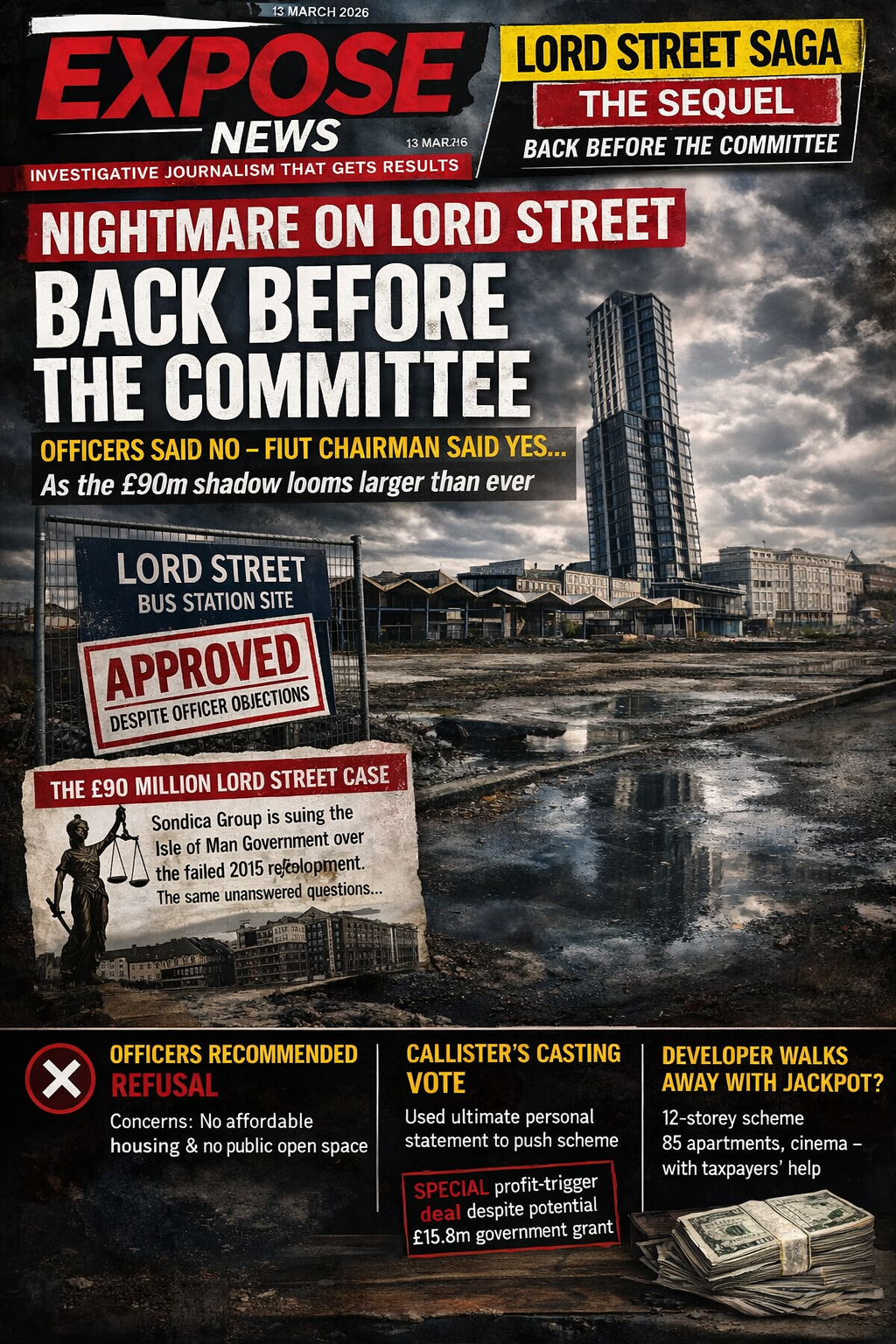
- Lord Street scheme returns to planning committee on Monday
- Officers are still recommending refusal of the application
- New flashpoint is a controversial ‘review mechanism’ tied to profit
- Tower block has been cut from 14 storeys to 12 – but the row is getting taller
- Read Part 1 of our mini-series here. Devon Watson on affordable housing
- And Part 2 here
- Now here’s Part 3…..
A prominent member of the Isle of Man business community has dubbed Lord Street ‘the unluckiest real estate on the Isle of Man.’
The businessman spoke out after the latest set of ‘bizarre and quite unrealistic’ plans were pushed back in front of the planning committee.
‘Firstly, the site is at the centre of the £90 million Lord Street case,’ he told Expose.News.

‘Secondly – after decades of DoI waffle – there still hasn’t been a single spade in the ground.
‘And now, the same outfit – who clearly never had the money for their original hotel scheme in the first place – have come along and hit the government with a double-whammy.’
He was, of course, referring to the latest twist in the long-running Lord Street saga.
The multi-million-pound redevelopment of Douglas’s former bus station site is due back before the planning committee on Monday after moving a step closer last week.
The revised scheme still includes a cinema and 85 flats, but the proposed tower block has now been reduced in height from 14 storeys to 12.
Even so, it would still be the tallest building in the capital. The planning officer is still recommending refusal.

At the last hearing, the planning committee declined to accept the officer’s recommendation to refuse the application, doing so on the chairman’s casting vote.
But rather than grant a clean approval, members paused the matter so that conditions and the controversial ‘review mechanism’ could be considered in more detail.
That mechanism is now the central battleground.
Under the proposal now being pushed by the applicant, Lord Street Development SPV Ltd would pay a commuted sum in lieu of affordable housing and public open space only if the development achieves a return above 20%, with any surplus above that figure applied to contributions capped at a total of £1,573,925.
Planning officers, however, are suggesting a three-stage review process instead.
Under that approach, if gross development value reaches or exceeds 17.5%, money would start flowing towards affordable housing and then public open space contributions, capped at £1,100,750 and £473,175 respectively.
In plain English, the argument is no longer simply whether the development should make a contribution.
It is about when, how, and under what level of profitability that contribution should kick in.
An objector has already described the applicant’s preferred approach as contrary to planning policy and untenable.
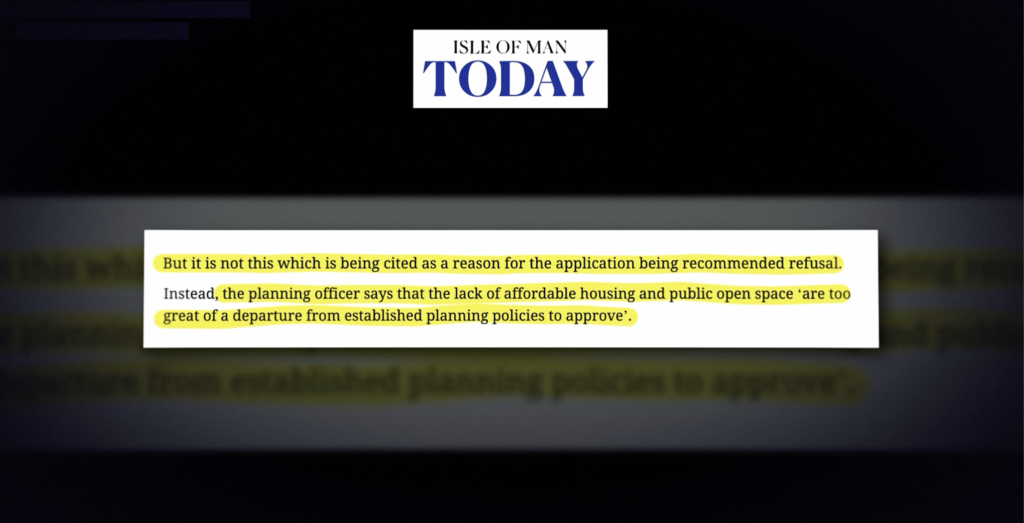
The planning officer, meanwhile, said such a review mechanism could only be considered acceptable because of the specific circumstances of this site – a brownfield development said to offer significant public benefit. He added that it was highly unlikely such an approach would be acceptable anywhere else.
That is what gives the latest hearing such political bite.
On one hand, ministers and departments talk constantly about regeneration, brownfield renewal and making central Douglas work again.
On the other, the committee is now being asked to weigh an arrangement under which affordable housing and open space obligations would effectively be made conditional on future profit.
And hanging over all of this is the possibility of a £15.8 million government grant through the Department for Enterprise’s Island Infrastructure Scheme.

That means a project being advanced as financially fragile enough to justify a diluted contributions model is also one that could still receive substantial taxpayer backing.
For critics, the optics are grim.
‘This is what makes Lord Street so extraordinary,’ the businessman said.
‘Everything about it seems upside down. The public takes the risk, the policy gets bent, and the private developer still wants the upside protected.
‘This site has become a symbol of drift, delay and official contortion.
‘The question now is very simple – does the planning system mean what it says, or does it only mean it until a big enough developer comes along with a glossy enough presentation?’
That, in the end, is why Monday matters.
Lord Street is no longer just another stalled development site.
It is becoming a live test of whether planning policy on the Isle of Man can withstand pressure when a scheme is dressed up as regeneration, while its most contentious obligations are pushed off into the future and made dependent on whether the numbers work for the applicant.
And that is why the latest chapter in the saga is not really about a tower at all.
It is about whether public policy bends at the exact moment the public most needs it to stand firm.
