

- Planning committee blocks refusal of the Lord Street redevelopment – but delays the final decision for two weeks
- 85 apartments and a 12-storey tower – with a cinema and city-centre units
- No affordable housing – and no public open space offered upfront
- Developer says even £1.5m in lieu would make the scheme unviable
- Yet a £15.8m government grant application remains open
- The ‘Double L’ backdrop: Lord Street politics collides with Liverpool terminal-style taxpayer fury
When Douglas Council Leader Devon Watson says housing is ‘completely unaffordable’, he is not offering a vague political slogan.
He is describing the pressure point he believes is driving people out of the Isle of Man – and the reason he decided to step into local politics in the first place.
This week, Watson’s warning – which he revealed in an exclusive interview with Expose. News last year – collided head-on with the latest twist in the Lord Street bus station saga.

A giant redevelopment plan for the long-vacant Douglas site has moved a step closer after the planning committee voted against an officer recommendation to refuse it – but then paused a final decision for two weeks while conditions are negotiated.
The scheme is vast: a mixed-use development comprising a multi-screen cinema, 85 residential apartments, a 12-storey tower block that would become the tallest building in Douglas, plus retail/leisure/restaurant units and office space.
The plans also include five bus stands with passenger waiting areas, a travel information centre, public toilets and bus driver welfare accommodation.
But the planning officer’s core objection was as blunt as it gets.
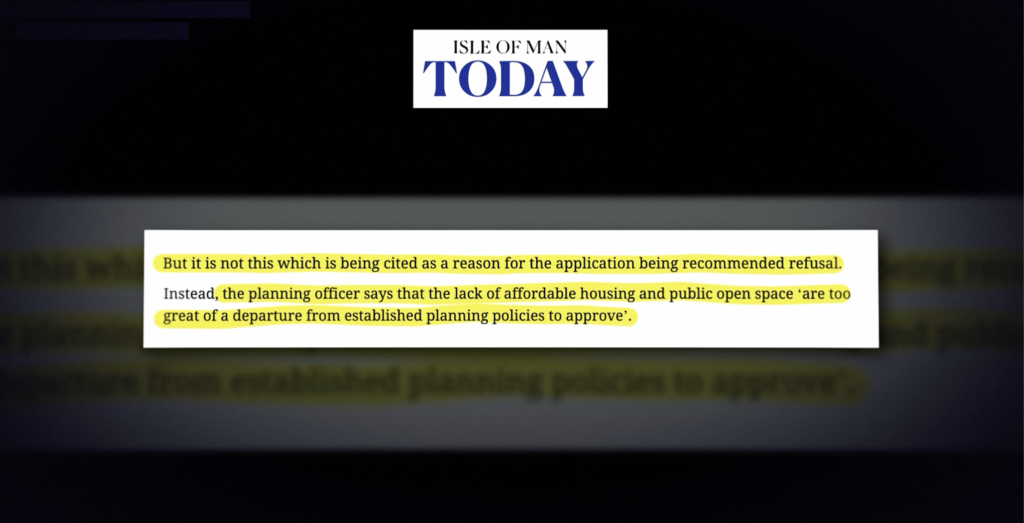
He did not recommend refusal because he disliked the height or the look.
He recommended refusal because the proposal included no affordable housing and no public open space – either as physical provision or as commuted sums – and he said that gap was ‘too great of a departure from established planning policies to approve’.
The developer’s argument, aired in the committee, was equally stark: even a £1.5m payment in lieu of affordable housing or public open space would make the scheme financially unviable.
Yet, the same hearing was told that an application for a £15.8m grant under the Department for Enterprise’s Island Infrastructure Scheme remained open and had been extended.
The project is expected to cost £64m, with a gross development value on completion of £80m.
It is that double whammy – no affordable housing, but still potentially a major taxpayer grant – that makes this moment politically volatile.

And it is why Watson’s previous comments on the wider housing crisis suddenly feel less like commentary and more like a warning flare.
‘I ran for council… because housing is completely unaffordable,’ he stated.
Watson says he put his name forward after Covid because he watched the Island tilt into a housing market that no longer matched wages or ordinary life-planning.
‘I ran for council immediately after Covid or right at the tail end of the pandemic because housing is completely unaffordable.’
His comments read like a call to action:
‘We saw housing prices shoot through the roof, and a lot of people just couldn’t afford to live on the island….
‘Many people, even who are solidly middle class live paycheck to paycheck and housing is completely unaffordable…..
‘A family should be able to afford a home on an average wage…’
Watson’s critique is not just about how high prices have climbed.
It is about what those prices do to a community.
In his view, unaffordability turns the Island into a place where people pass through – but cannot settle.

‘At the same time, housing prices are far too high…
‘And if you can’t afford a home here, you might as well be in a place like Manchester or London…
‘And if you can’t afford housing, then you don’t really have a solid link or thing that roots you down into the community…’
This is the frame through which Watson views big, prestige developments.
Not as architecture debates – but as decisions that determine whether ordinary residents can live in the places being ‘regenerated’.
‘Young people are leaving… because housing is completely unaffordable.’
Watson argues that the Island is already paying a demographic price for its housing market.. and that price is likely to compound if new supply is targeted only at ‘a particular category of purchaser’.
‘….a lot of young people are leaving and people are leaving because housing is completely unaffordable,’ he continued.
‘I think that we need to try and keep more young people on the island for a range of reasons.’

In the Lord Street case, the politics are sharpened by what the Department of Infrastructure has recorded in planning memoranda: the applicant has previously stated it did not wish to provide affordable apartments on the site because the concept was aimed at a particular category of purchaser and would not be a suitable location for first-time buyers or public sector homes for rent.
Watson’s point is that you can’t build an Island’s future on housing that excludes the next generation from the centre of its capital.
Continued in Part 2.
