
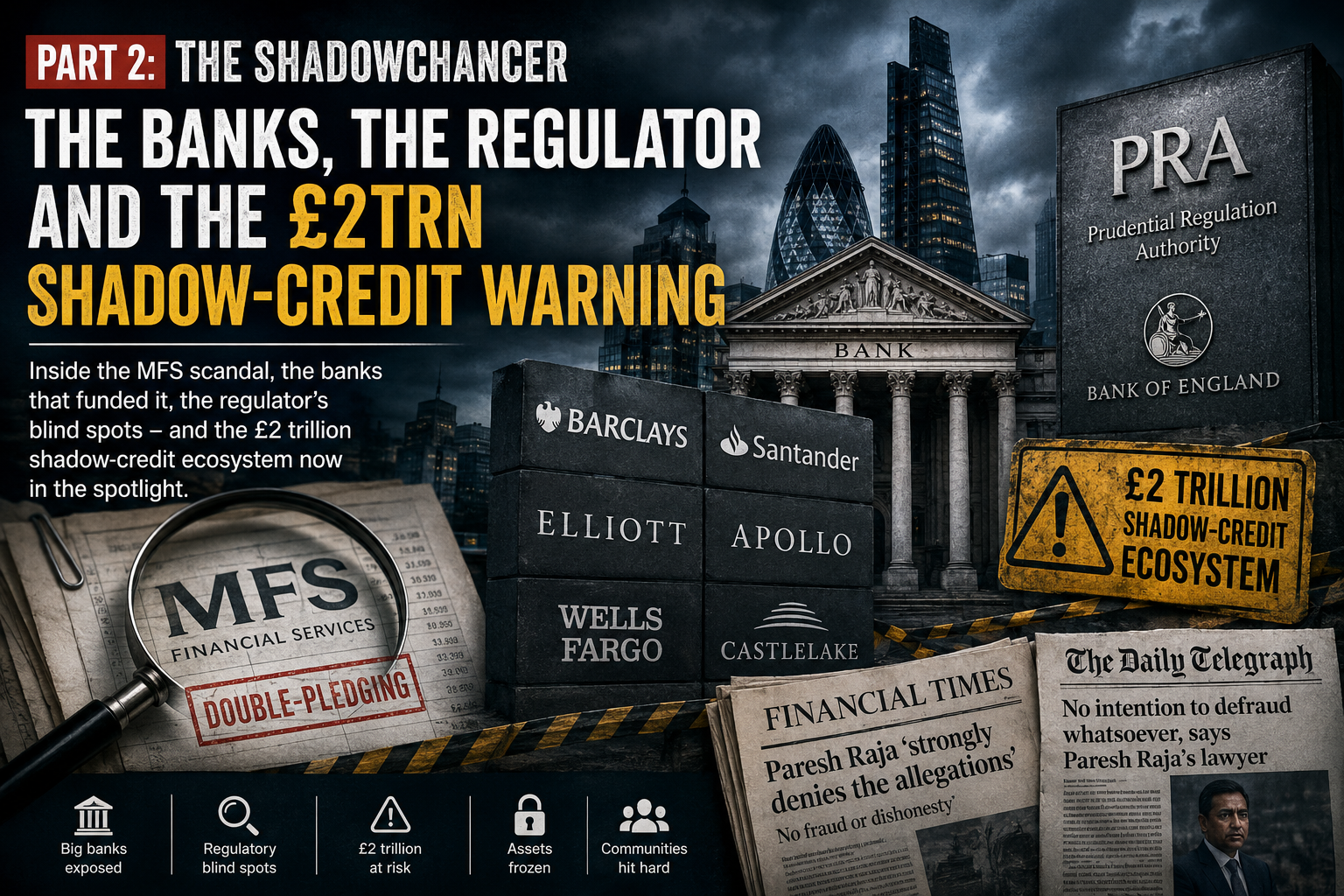
The Banks, The Regulator And The £2trn Shadow-Credit Warning

In the second part of a new ShadowChancer series, junior City reporter Rohan Gupta explores the wider implications of the biggest banking scandal since the 2008 crash.
- The MFS scandal is also a story about the institutions that funded the lender.
- Barclays, Santander, Elliott, Apollo, Wells Fargo and Castlelake all appear in the funding chain.
- The Bank of England’s PRA has asked exposed banks what checks were carried out.
- The FCA’s limited remit over Annex 1 firms has raised questions over regulatory blind spots.
- The collapse has landed amid wider warnings about the £2trn private-credit ecosystem.
- Paresh Raja denies wrongdoing, with denial positions reported by the Daily Telegraph and the Financial Times.
By Rohan Gupta
Expose News City Desk
In Part 1 of ShadowChancer, our reporter traced the alleged double-pledging network, the shell companies and the Twinwin allegations. Expose News also probed the property empire linked to former Bangladesh land minister Saifuzzaman Chowdhury and the banks behind the billions.
Part 2 begins with the harder questions: once the biggest financial institutions were exposed, where were the regulators, what checks were carried out, and does the collapse point to a wider threat in the £2 trillion private-credit system?
Raja denies wrongdoing. His lawyer told the Daily Telegraph that there was “no intention to defraud whatsoever” and that the allegations were “materially incorrect”. The Financial Times reported that his spokesperson said he “strongly denies the allegations” and maintains there was “no fraud or dishonesty”.
This conflict is very visible. If the deception was happening on a “massive scale”, why didn’t the legal teams of Barclays identify it sooner, before providing £600 million?
Reports from the Financial Times and Bloomberg suggest that Castlelake was the first entity to notice the problem. The investment fund had already lost money because of two American companies, Tricolor Holdings and First Brands Group, that failed due to double-pledging problems.
When Castlelake increased its scrutiny of MFS’s ledger at the end of 2025, the numbers didn’t add up. Barclays froze the MFS accounts in January 2026. MFS was placed under legal administration by February.
The Bank of England’s Prudential Regulation Authority has now contacted Barclays, Santander and other exposed banks with the direct question: what checks did you really carry out?
These exposed banks claim they were deceived. But were they truly fooled — or just turning a blind eye?
Where Were The Regulators?

MFS was not a bank. It was classified as an “Annex 1 business” — a category for small firms facing minimal regulation.
The Financial Conduct Authority had the power to review the paperwork, but it had no power to review the finances, set capital rules or conduct stress checks. For all its size, MFS was watched less closely than a high-street pawn shop.
The FCA warned all Annex 1 firms in March 2024, flagging poor customer risk assessments and outdated financial crime controls, especially as their business grew.
MFS commissioned DWF, a leading City law firm, for its review. Their verdict? MFS met all anti-money laundering regulations.
This timeline is damning for the reputation of the involved parties:
- Early 2024: Bloomberg released its investigation unravelling MFS’s role in funding Chowdhury’s property empire.
- March 2024: The FCA issued a warning to Annex 1 companies.
- Mid-2024: MFS was given approval by DWF, with no financial wrongdoing found.
- June 2025: The National Crime Agency froze £185 million of properties financed by MFS.
- February 2026: MFS collapsed.
The Spotlight on Corruption group criticised the FCA for outsourcing these compliance checks, arguing that the practice lacked a uniform approach and was vulnerable to a “conflict of interests”.
One more detail: weeks before MFS collapsed, a High Court judge ruled Raja had “an obvious intention to create deceptive documents to justify illegitimate payments” in a Dubai property case.
This should have raised serious red flags about MFS’s leadership. The judgment was public record. So what happened? No regulator, lender or authority stepped in.
The True Cost? Not Just The Numbers
Among this wreckage, not everyone caught out was a shady figure.
Dr Elizabeth Donald, a GP, now risks losing her home after it was linked to Twinwin, the accused firm. She is among the many legitimate borrowers sucked into this mess.
The fallout has reached vulnerable sectors, including special needs education providers, dementia care and retirement housing firms.
Where were the financial oversight committees? The assets — student flats, shopping centres and city properties — are not just numbers. They are assets in communities across the country.
It is not only about the losses. It is about who profited.
Is This A £2 Trillion Financial Crisis Waiting To Explode?
MFS was not alone. It thrived within a blind spot which regulators now realise is a systemic problem that needs to be addressed.
There is an under-regulated £2 trillion credit ecosystem with minimal oversight. This goes far beyond the reach of standard banking regulations. The lending operates in the shadows — hidden, complex and growing fast.
On 5 May, the Financial Stability Board flagged private credit as a growing threat, citing hidden risk from murky valuations, lack of transparency and bank entanglements.

In January 2026, the House of Lords published Private Markets: Unknown Unknowns, warning that regulators are operating blind when it comes to assessing systemic risks in private credit and private equity.
It urged the Bank of England to be given new authority and power to collect data from these private credit firms and closely monitor their financial stability.
In a landmark move, the Bank of England has begun its first voluntary stress tests for private credit, with results not due to be public until early 2027. The European Union has also tightened its grip on shadow banking, introducing new regulations for banks expected to be in place by January 2027.
JP Morgan chief executive Jamie Dimon has called these private credit firms “cockroaches”. Dimon argued that when you spot one, there are “probably more”.
MFS survived 20 years. How many more are hiding in the dark?
What Happens Now?
Paresh Raja is still in Dubai, restricted to £5,000 weekly by a worldwide asset freeze. His legal team denies wrongdoing, but a £1.8 billion claim looms.
The FCA is still investigating. The Bank of England is reviewing oversight of banks. More than 250 property firms are being dismantled.
The students living in the accommodation in Liverpool were unaware. The banks claim they were victims too. The FCA says it lacked broader powers. DWF says it was acting on the data it was provided.
But the £1.3 billion hole is real. The frozen assets are real.
Bloomberg exposed it. The NCA acted. A judge warned. Yet no one stopped it.
If MFS flew under the radar for 20 years, what else is hiding in plain sight?
Source note: Raja denial wording is attributed in the copy to the Daily Telegraph and the Financial Times. Direct quotation has been kept short and the broader denial position is summarised.
