

Housing pressure, rising costs and controversial planning decisions are combining to push a generation off-island, raising questions about the Island’s long-term direction…….
For years, the Isle of Man has faced a steady outflow of young people.
What is changing now is the scale – and the growing evidence – that this is no longer simply a cycle of education and return, but a structural shift driven by affordability, opportunity and policy.
Official figures show that people aged 20 to 24 account for more than 40% of all departures from the Island.
At the same time, graduates are increasingly being discouraged from returning, with housing access and cost of living cited as key barriers.
That pressure is unfolding against a backdrop of increasingly contested planning decisions.
In Douglas, the ongoing Lord Street development has become a focal point of debate.
The current proposal led by a private development vehicle, includes 85 flats, yet does not guarantee a single affordable home, with contributions instead tied to profitability thresholds.
The consortium behind the scheme, Lord Street Development SPV Ltd., is led by controversial businessman Stephen Bradley, boss of Kane Ltd., that purchased the former bus station from the government in 2017.
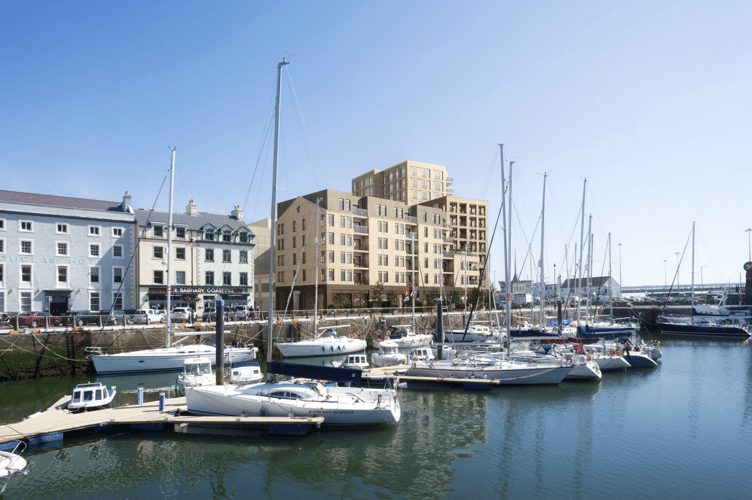
The cream / pale yellow building in the centre is a computer graphic which shows how the Lord Street development could look. (Credit: Lord Street Development SPV Ltd.,)
However, the legitimacy of the original sale is now being fiercely challenged by another developer called Sondica Group Inc., which was the frontrunner.
Sondica claims that the Treasury, the DoI and consultants Lambert, Smith Hampton acted corruptly when it did the deal, and is now suing for £90 million.

Sondica’s state-of-the-art, mixed-use plan provided for a Winter Garden alongside a hotel – but the government turned down the deal in a shock, last-minute move, now at the centre of the notorious £90 Million Lord Street case.
But for some observers, this raises a broader question about how housing policy is being applied in practice particularly at a time when affordability is already being identified as a key factor driving younger residents away.
The result is a demographic imbalance that is becoming harder to ignore.
A Generation Priced Out
A recent Tynwald Youth Select Committee report concluded that the Island’s housing system is failing young people, highlighting the inaccessibility of independent living and the lack of focus on first-time buyers.
The report also pointed to the need for smaller, more affordable properties, particularly for single people and young households, alongside concerns about the standard and regulation of rental accommodation.
Those findings are echoed in public discussion.
In online forums where young people discuss life on the Island, housing emerges repeatedly as a central barrier.
One contributor described the situation starkly:
“Can’t get a house without a job. Can’t get a job without a house.”
Another highlighted the financial pressure faced even by those in work:
“I earn just too much, so my wife gets nothing at all… After my £1500 rent, 200 gas, 200 electric… I was left with £40 last payday. But I earn too much.. mustn’t expect us to need to eat.”
These comments, taken from Reddit discussion threads about life on the Isle of Man, reflect a wider pattern: for many, the cost of establishing a stable life on the Island is becoming prohibitive.

A System Under Strain
The demographic consequences are already visible.
Despite continued population growth, this increase is being driven almost entirely by inward migration. Between 2021 and 2024, new arrivals have filled gaps left by those leaving, with most incoming residents aged between 25 and 44.
At the same time, the Island is experiencing natural population decline, with deaths significantly outnumbering births.
Government policy has increasingly focused on addressing labour shortages through migration, with plans to attract workers from off-island and create thousands of additional jobs by 2032.
But this approach sits alongside a parallel challenge: the inability to retain the Island’s own young workforce.
Critics argue that this reflects a deeper structural issue.
Trade union representatives have described the situation as a “political failure not an accident”, arguing that young people are leaving because they “cannot afford to stay, cannot progress, and cannot see a future”.
They point to years of underinvestment in skills, apprenticeships and long-term workforce planning, alongside the rising cost of living, as key drivers of the trend.
Cost, Opportunity, and Trade-Offs
Across public discussion, a consistent theme emerges: the Island increasingly works best for those already established, or earning at a higher level.
For younger people or those on average incomes, the equation looks very different.
As one commenter put it:
“Most I know leaving the island is due to the cost to live here.”
Others point to the broader structure of the economy, where tax advantages can benefit higher earners, but are offset for others by higher living costs, limited competition and additional expenses linked to island life.
Housing sits at the centre of this tension, not only as a cost issue, but as a gateway to stability, employment and long-term settlement.

A Case Study in Policy Tension
These pressures are not occurring in isolation. They intersect directly with how housing policy is being applied in practice.
The ongoing planning dispute over the Lord Street development in Douglas has become one of the most visible examples.
The current proposal includes 85 flats in a major town-centre scheme. Yet under the latest plans, not a single affordable home is guaranteed.
This stands in tension with the Island’s own policy framework, which sets a 25% affordable housing expectation, equivalent to around 21 homes on a development of this size.
Instead, contributions towards affordable housing are tied to developer profitability, meaning they may be reduced, delayed or not delivered at all depending on financial returns.
At the same time, the scheme has been linked to a potential £15.8 million application for public support through the Island Infrastructure Scheme.
The combination raises a broader question:
If affordability is already a barrier driving young people away, what does it mean when major developments proceed without guaranteed affordable provision, while still seeking public backing?
Planning officers have themselves noted that the proposed approach would be unlikely to be accepted on most other sites.
For critics, that suggests a system that is becoming increasingly flexible in high-profile cases ,even as underlying problems remain unresolved.
A Wider Pattern
Taken together, the trends point to a reinforcing cycle.
- Young people leave due to cost and limited opportunity
- Their departure creates workforce gaps
- Those gaps are filled through inward migration
- Structural issues, particularly housing affordability, remain
Over time, this cycle risks reshaping the Island’s demographic and economic profile.
Population growth continues, but the composition of that population is changing, and not necessarily in a way that addresses long-term sustainability.
The Question Ahead
The Isle of Man is not alone in facing housing pressure or demographic change.
But its size, isolation and economic structure mean the effects are more immediate, and potentially more difficult to reverse.
The data shows young people are leaving. Their own accounts explain why.
The question now is whether the policies shaping the Island’s future are aligned with retaining them or whether they are contributing, however indirectly, to the conditions pushing them away.
Because without that alignment, the risk is not simply that a generation leaves.
It is that the Island becomes increasingly dependent on replacing the people it cannot keep.
