
- Allegations made of a possible conspiracy to conceal information by the Department of Infrastructure.
- Winning bidder was set-to revamp North Quay a decade ago – but was suddenly dropped after ‘undue pressure’, lawyers claim.
- Now Sondica Group Inc., tells court that it’s ‘suspicious’ that ‘a significant number of documents (are) missing.’
- First Deemster Andrew Corlett said the issue of missing disclosure was a ‘concern’ and that the length of time it was taking was ‘disturbing.’
- But the DoI and Treasury insisted they were doing the best to find the documents.
- Their lawyers deny allegations of corruption, malfeasance in public office, negligent misstatement
An alleged bungled government disclosure exercise in the long-running Lord Steet case could end up costing the IoM taxpayers up to £90 million.
Property developers Sondica Group Inc., is suing the Department of Infrastructure (DoI) and the Treasury after its consortium lost a bid to redevelop the 3.17 acre Douglas site nearly a decade ago.

In 2015, the DoI began the tendering process with a view to developing Lord Street and Parade Street, parts of which had remained derelict since the old bus station had closed down.
Sondica – which was the project sponsor for the North Quay Consortium – revealed plans for a £55m state-of-the-art building, including a Marriott ‘Courtyard’ Hotel, and a public access Winter Gardens, linking to a new bus terminus.

Detailed proposals were also submitted for a four-screen cinema, a Marco Pierre White New York Italian restaurant, and a brand-new APCOA car park to replace the ad-hoc lot which had grown-up on the land, often described by locals as a ‘bombsite.’
Around 55,000 sq ft of shops and office space was also envisaged, described as a ‘unique development opportunity’.

In order to ensure fair play, specialist UK consultants Lambert Smith Hampton were appointed by the DoI as professional advisers to independently assess the bids.
Sondica was favoured, but in March 2016 a top-level steering committee unexpectedly reversed the decision, and advertised for fresh bids.
The DoI’s officers claimed that the Sondica-led consortium wasn’t acceptable because they had asked the government for financial undertakings, of around two million pounds a year, which they described as ‘irregular.’
Sondica later disputed this interpretation, claiming that the deal would have been at zero cost to tax payer, without the need for any grant funding.
In addition, the consortium stated that the government could retain ownership of the land at the end of the lease, and earn a guaranteed £400,000 return per year.
However, the DoI insisted that the bid would need to be run-again.
Once more, Sondica joined the race for a second round, but a rival called Kane Limited submitted a lower offer of £600,000.
This price was immediately accepted even though value was far below Sondica’s initial bid of £4.1m.
Kane unexpectedly won the competition despite having been rejected at an early stage in the first round

Lawyers for Sondica claim that their team were immediately suspicious that the process had been rigged in a way which was detrimental to their bid.
Sondica’s court claim now alleges that ‘undue pressure’ was put on LSH by a DoI official to substantially amend its independent expert report resulting in Sondica being downgraded as the preferred bidder.
Last week – at a case management hearing at Douglas’ Courts of Justice – in a bid to get more transparency on what exactly happened, Sondica’s lawyer honed-in on this specific phase of the process in which a DoI official was finalising the paperwork.
Advocate Victoria Unsworth made claims of email ‘tampering’ of the disclosure of email messages that were going back and forth between the government departments and LSH.
In a legal document she drew attention to ‘a number of emails that have clearly been tampered with by the First and/or Second Defendants (the DoI and Treasury) as part of the overall disclosure process.’
With regard to missing documents, Ms. Unsworth focused in on ‘multiple drafts of the letter proposing the winning bid to Kane in early 2017,’ which her clients would like to see but have yet to be disclosed.
Ms Unsworth has now asked for ‘selected’ electronic versions in their original format, around ‘critical dates’ which would show ‘comments’ made by officials who made the decision to exclude Sondica, and all the emails that fed into the document’s creation.
Her application for further disclosure stated: ‘The Claimant therefore seeks that all of these relevant emails are produced in native format. These comments will be critical to establishing the facts of this case.’
Ms Unsworth claimed there are more than 100 documents that the two government departments had failed to disclose, describing ‘serious and persistent issues’ with their approach to the process.
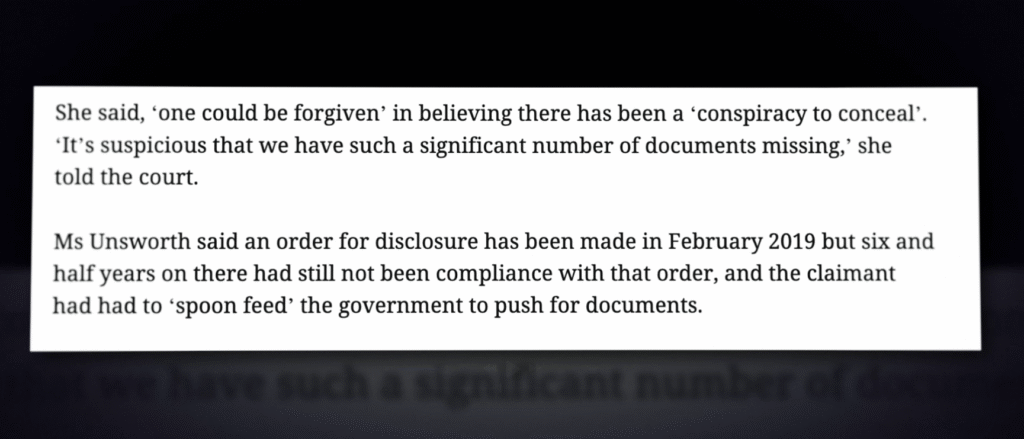
‘One could be forgiven’ she told the court, in believing there has been a ‘conspiracy to conceal.’
‘It’s suspicious that we have such a significant number of documents missing.’
Sondica is claiming damages for breaches of contract and duty, as well as losses, plus interests and costs which have been estimated to now be in excess of £90 million, but could rise further if the case drags on.
First Deemster Andrew Corlett is keen to prevent further delays and commented: ‘The timescale is disturbing for all sorts of reasons. This has gone on long enough. This matter needs a trial date fixing. We are looking at early next year really.’
The Douglas-based firm alleges ‘negligent misstatement’ against an officer in the Treasury for describing their structured finance as ‘irregular’ and potentially compromising the contract.
Sondica also alleges misfeasance in public office, and complained on Friday that government departments had not complied with disclosure orders for six and half years.

The process of ‘spoon feeding’ the government in order to get more documents had been ‘extremely painful and costly,’ Ms Unsworth said.
‘We are told they don’t exist, or they can’t find them and then ultimately produce them.’
But advocate representing the DoI and Treasury, David Keates, insisted: ‘We are doing the best we can to find these documents.’
Mr. Keates said some documents had already been disclosed, but others fell outside the parameters of the agreed search terms.
But in a legal document, Ms Unsworth hit back: ‘It is unbelievable that these emails are not in the possession of the First and Second Defendants (given the email recipients) and further have inadvertently been missed in the disclosure searches over the course of 6 years.’
Sondica have also specifically asked for ‘emails which have a different time stamp’ from those already disclosed and raised concerns that documents had ‘not been accurately checked.’
With regard to claims of interfering with disclosure, Ms Unsworth stated: ‘The tampering can be seen from other chains of emails where the full content of the email is within the chain.
‘It is important that this email account is produced in native format in order that it may be ascertained from the meta-data who may have tampered with the content of the emails and when, given the nature of the allegations in these Proceedings.’
The issue of disclosure has been a running sore in the case.
Deemster Corlett added that the estimate ‘defies common sense to me,’ which ‘makes a mockery of litigation,’ and that such a cost to taxpayers is ‘unacceptable’.
A scenario which the judge said ‘is not that complicated’ despite having ‘dragged on’ since 2018.
Sondica Group was initially chosen as the preferred developer for Lord Street – a controversial, long-abandoned former bus terminus often described as an ‘eyesore’ and a ‘bombsite’ – only for its ‘state of the art’ plan to be rejected the next month.
