
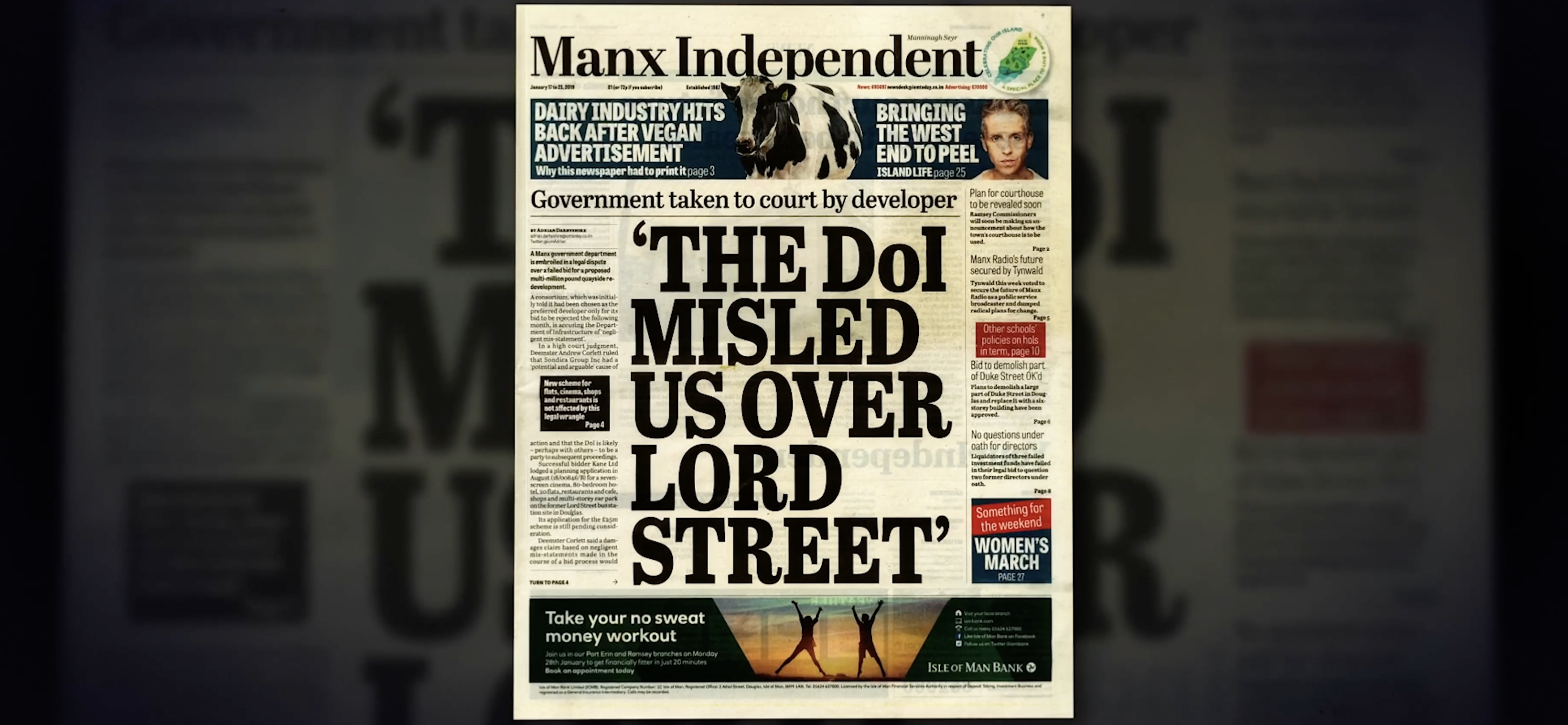
- Manx government on the hook for huge potential claim.
- Court case started-off as a ‘run-of-the-mill’ dispute between a private company and two government departments and their professional advisors, six years ago.
- But bureaucracy and delays by government lawyers has seen fees ‘spiral of control,’ according to observers.
- Meddling by ‘fat cat’ consultants and differing official excuses have also been blamed.
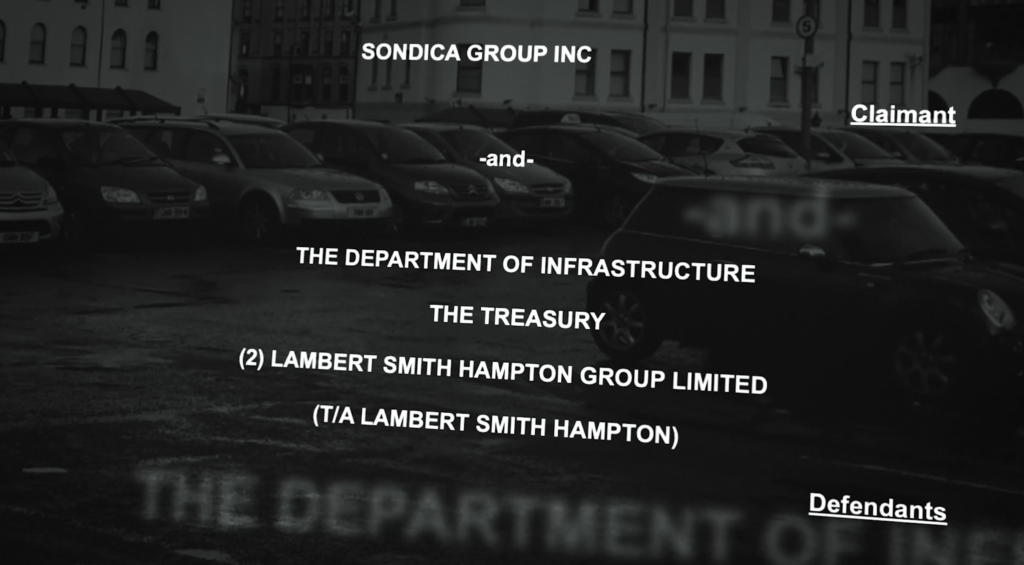
- Manx government ‘consultancy culture’ is under fire as blue-chip advisor Lambert Smith Hampton stands accused of malfeasance – which they deny.
- Initially the claimants valued their case at £50 million to £90 million.
- Now, insiders say, as proceedings drag on the likely figure will be north of £100 million ‘unless the government sees sense.’

It’s not often that a low-key planning dispute, taking place in a modest court room in a quiet much ignored region of the UK, has potential ramifications on the international money markets.
But that’s what is happening at the Courts of Justice in Douglas, the blowy capital of the Isle of Man.
Baffled residents, on the independent territory 30 miles off the coast of North West England, have been left scratching their heads and asking themselves ‘why?’
Mainly pondering why their hard-earned tax pounds – enough to build a new hospital or ten schools on the island, by some accounts – are at risk from a ‘not that complicated’ legal disagreement (the judge’s words), which could have been settled years ago.
The property dispute question is set to spiral out of control – and costs could top £100 million, sources close to the case are warning.
The only problem is that the party being sued is the government of the island – including two departments, and their independent advisor – and the public purse is on the rack for any losses.
Which means that a bumper payout is likely to affect the island’s gold-standard credit rating on Wall Street and in the City of London.
The issue of budget-busting fees was brought sharply into focus last week at the latest hearing in the case, in the markedly unpretentious court room of First Deemster Andrew Corlett.

Deemster is the name given to a judge on the Isle of Man, which still uses traditional titles for official positions and institutions, one of many slightly quirky customs which sets the 1500-year-old community apart from the mainland.
Their parliament is known as the Tynwald and believed to be oldest continuous legislature in the world.
Deemster Corlett added that the estimate ‘defies common sense to me,’ which ‘makes a mockery of litigation,’ and that such a cost to taxpayers is ‘unacceptable’.
A scenario which the judge said ‘is not that complicated’ despite having ‘dragged on’ since 2018.
Sondica Group was initially chosen as the preferred developer for Lord Street – a controversial, long-abandoned former bus terminus often described as an ‘eyesore’ and a ‘bombsite’ – only for its ‘state of the art’ plan to be rejected the next month.

The Treasury Department are also facing claims of negligent mis-statement, also denied.
The project was eventually awarded to another developer, which also had a big vision, but one that has remained unfulfilled – the site is still a grim-looking car park – adding to local concerns that the government made a bad call in squashing Sondica’s potential.
Residents claim that the same street has been a graveyard of broken promises for over 20 years.

In an earlier episode of this series, Isle of Man journalist and broadcaster Paul Moulton told Expose.news:
‘This is Lord Street… and this should have been the sort of jewel in the crown of the whole thing.
‘But alas, due to various issues I would love to know more about…. this has not happened… and court cases are on the way…
‘They’ve been promising the world…..but we are still left with just this bomb site in Douglas.’
Now, some observers have been left mystified as to how relatively ‘ordinary’ commercial dispute has dragged on for six years, with each passing phase causing the final bill to potentially go up by millions.
A court report of the recent hearing triggered feverish local debate on an online forum.
One commentator called Gladys wrote: ‘The Deemster’s comments on that are pretty damning.’
Another known as the Thefella added: ‘So now the Deemster is saying the costs quoted are far too much and it’s not economically viable. Yes perish the thought a half decent UK law firm might have the opportunity to independently review whatever crock of **** paper trail was drawn up by the AG’s Office and used to decline the preferred bidder.’
For many locals, the Sondica case is symbolic of a bigger issue – an ineffective government which has losts its way, they claim.

Once proud of their financial sophistication – the island was a booming low-tax economy for decades – some residents think the government is at risk of becoming a laughing stock after a series of doomed big-ticket projects.
Former Manx politician and media boss Juan Turner, who served on the Legislative Council for 11 years, has accused the Tynwald of incompetency, cronyism and institutional corruption.
He told Expose.News: ‘This is going on all the time, where they’re botching up contracts’ tenders. And whether there is somebody involved somewhere with a brown envelope, who knows? I would suggest it’s more incompetence, in honesty…..
‘I would say the bulk of it is sheer incompetence…..It’s just woeful…
‘The millions of pounds are just flowing out of that government for all sorts of botched scheme decisions. And nobody has ever held accountable….
‘There’s just no end to these things happening, and they just seem to keep bumbling from one disaster to another.’

But it is the threat to island’s much coveted Aa3 stable credit rating – the same as the United Kingdom as calculated by the international agency Moody’s – which is seen as a more long-term and serious reputational risk, not least because it could end up costing even more money if interest rates are forced up.
The island’s reputation, for being a save haven for tax efficient investments and prudent legal and accountancy advice, is on the line according to some professionals, our reporters spoke to.
An Isle of Man businessman, who agreed to talk to Expose.News on condition of anonymity, said: ‘I don’t think anyone in government has thought about the bigger picture here, or even sees the threat to our credit rating coming down the track, or for that matter our reputation.
‘All litigation is designed to settle – to save court time, which is costly, and to stop parties causing disproportionate damage to each other.
‘This case is no different. Otherwise, if the case goes on, there a good chance that legal costs in damages and fees spiral to an estimated £100 million, paid for out of the public purse – a sum so big and unbudgeted, that it will damage the IoM’s credit rating and the IoM will be forced to dip into reserves, just like happened during Covid.
‘To put that in perspective, £100 million, dwarfs the total spend on infrastructure by the IoM government this year, or is enough to buy a new hospital, or ten new schools.’
Or to put it another way, £100 million equates to 43 % of the government’s £230 million spend over the next 5 years.
To others, the case represents a more sobering problem – that the Isle of Man is trapped in vicious circle of decline.
The Isle of Man once attracted the brightest and the best to work in its professional services.
But in recent years the fortunes of the island have declined.
Competition from other low-tax residences around the world, tighter regulation and increased transparency spelled the end of the boom.
In a bid to attract and retain new business and younger residents, from outside and at home – and to diversify into new sectors – the government embarked on investments in infrastructure to improve facilities and encourage local firms to come up with innovative ideas.

Sondica were at the ready and their Lord Street plans were a good example of a development that aimed to improve life on the island, including mixed use resources such a 4* hotel with a Michelin-starred restaurant, a new bus terminal, a contemporary wintergarden atrium, desirable apartments, a cinema, a retail complex and tourist attractions.
But it never happened and other programmes have floundered alongside it.
Consequently, the young professionals either haven’t come, or the newcomers have deserted after only a few years and homegrown talent has often fled to the bright lights of the mainland metropoli.
Juan Turner added: ‘Lord Street is just continuing to be an embarrassment to the town centre with regard young people, there’s an often cry that there’s nothing here to do……
‘Whereas young people who want a vibrant lifestyle, they’re attracted to the cities. Now we’ve seen a boom in places like Manchester with all the things that are going on there. There’s always festivals, there’s music venues, there’s a whole lifestyle outside work. Whereas here at five o’clock, the town is dead. Once all the cars have gone home, the place is dead.
‘How do you generate that? Because no one’s going to open a business unless there’s trade and you’re not going to develop the trade unless there’s somewhere to go. So there’s a real problem, real problem here.

‘Now, if you add that to the cost of getting here for young people who might want to make this their home and maybe commute, that’s a serious problem because nobody’s going to be paying a couple of hundred pound a week to get on and off the island….
‘The cost of housing here is sky high. Young people have very little chance of getting themselves a decent accommodation, rented accommodation, the cost are sky high. So if you are a young person looking to make your life here already, there’s a long list of things that go against your decision to remain on the island.’

CANNAN BLOWS APART £2BN WIND FARM DREAM AS MANX ECONOMY SHRINKS