
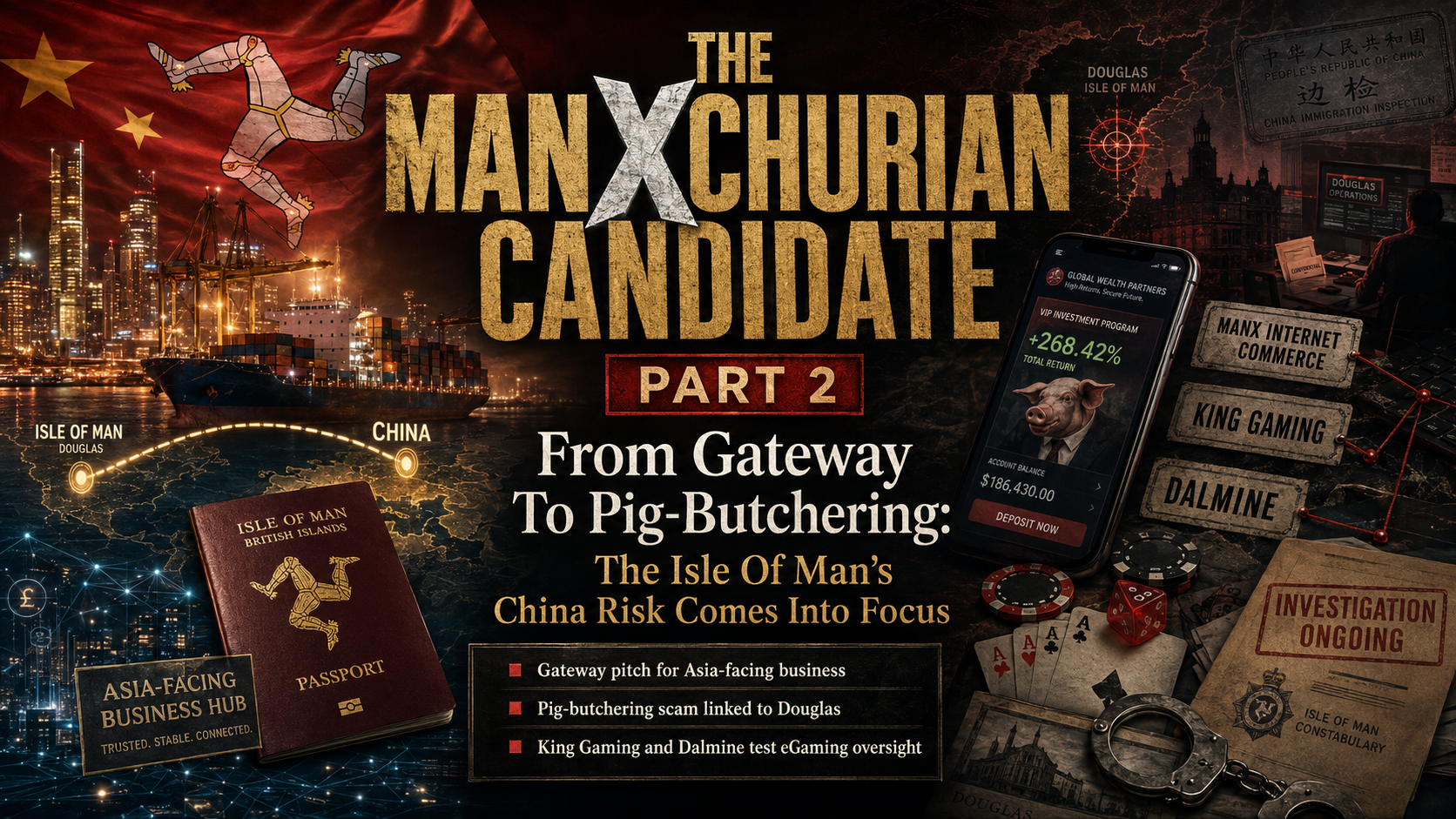
From Gateway To Pig-Butchering: The Isle Of Man’s China Risk Comes Into Focus
- The Island sold itself as a fast, flexible and well-regulated gateway for Asia-facing business.
- A pig-butchering scam linked Chinese victims to operations connected to Douglas.
- King Gaming and Dalmine turned a local enforcement story into a test of eGaming oversight.
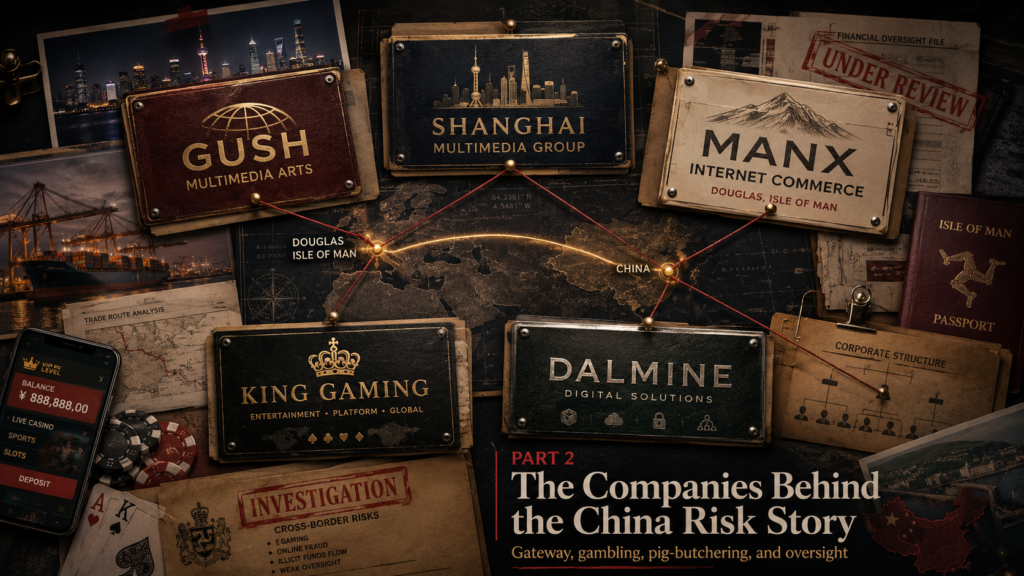
The practical links between the Isle of Man and China were already visible long before the latest passport row.
In its account of Ambassador Liu Xiaoming’s 2013 visit, the Chinese Embassy referred to Manx companies doing business in China or having products made there, Chinese companies being helped onto London’s AIM market, cooperation in ship registration, and school exchanges between Ballakermeen High School and No.1 Middle School of Liuyang in Hunan Province.
Later came more examples. Gush Multimedia Arts, linked to Shanghai Multimedia Group, established an Isle of Man presence in 2015 with ambitions to use the Island as a European base for 3D and virtual cinema technology. Three FM reported that Shanghai Multimedia Group had established Gush Multimedia Arts Ltd as “the latest in a series of companies enticed here by government”.
In 2016, the Island signed a Memorandum of Understanding with the Shanghai Municipal Commission of Commerce to promote economic cooperation, trade and investment.
The pitch was clear.
The Isle of Man wanted to be a gateway: for shipping, company structures, finance, technology, tourism, education and Chinese business looking towards the UK and Europe.
But that opportunity came with an assumption — that the Island could plug itself into Chinese and Asia-facing growth while staying in control of the risks.
In recent years, that assumption has come under pressure.
The issue is not that the Island had links with China. Trade, travel, education, shipping and legitimate investment are all normal parts of international life.
The issue is that the Isle of Man sold itself as fast, flexible, international, business-friendly and well-regulated. Those qualities attracted genuine companies. But they could also attract opaque businesses operating across borders, especially in sectors where money, data, gambling, crypto and company structures move faster than regulators.
That is where the Island’s China story becomes more uncomfortable.
The clearest example is the so-called pig-butchering scam linked to Manx Internet Commerce.
In 2024, Isle of Man Today reported on a BBC investigation which found that scammers operating from the Isle of Man had fleeced more than £4m from victims through an investment fraud.
The report said six people involved in the scam worked in Douglas for a company called Manx Internet Commerce, and that Chinese court documents showed the fraud ran between January 2022 and January 2023.
The method was the now familiar “pig-butchering” model: victims are befriended online, gradually encouraged to trust a fake investment platform, and then stripped of their money.
That story mattered because it was not abstract.

The victims were in China. The operation was linked to premises in Douglas. The convictions were in Chinese courts. And the reputational damage landed back on the Isle of Man.

Then came King Gaming and Dalmine.
In April 2024, the Isle of Man Gambling Supervision Commission suspended the licences of King Gaming Ltd and Dalmine Ltd, saying it was aware of an ongoing criminal investigation into companies it regulated and had taken the decision pending a regulatory review.
The following day, Manx Radio reported that the licences had been suspended while a criminal investigation was carried out. Local reporting later said police had made seven arrests as part of a fraud and money-laundering investigation connected to King Gaming, with officers raiding business premises in Douglas.
Again, the issue was not simply one company. It was the model.
The Isle of Man had built a major eGaming sector on the promise that it could licence and supervise online gambling businesses to a high standard. But Asian-facing gambling is difficult to police. Customers may be in restricted markets, brands may operate through layers of white-label arrangements, ownership can be difficult to identify, and money can move through complex payment chains.
That is why King Gaming became bigger than a local enforcement story.
It raised a wider question: had the Island’s eGaming growth outpaced its ability to understand what some operators were really doing?
